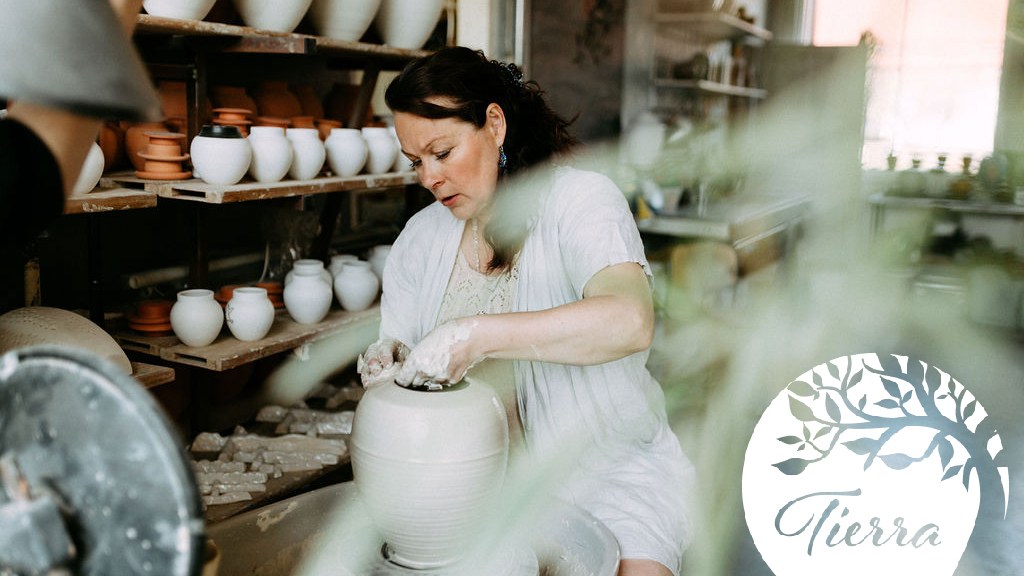
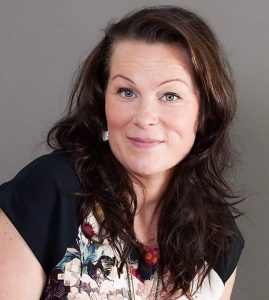
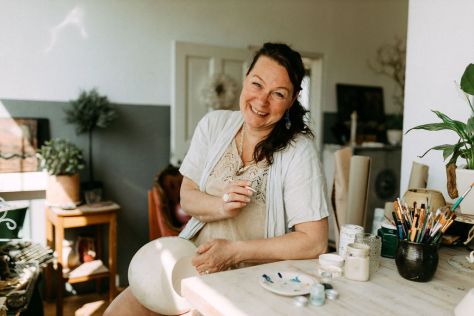
 Today I have the pleasure of introducing Finnish artist Pia Zettinig from Turku, where she was born and lives, working in her art studio, “Tierra Finlandia.”
Pia is a visual artist with a strong, but I would say above all natural, ability to shape clay into forms that contain space for life, death, and the transitions in between.
Her practice ranges from public art to sculptural reliefs and ecological cremation urns: works that blend craftsmanship, ethics, and emotional intelligence.
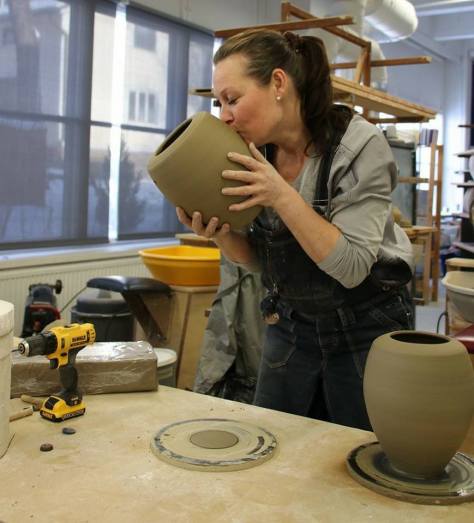
Clay entered her life very early, having grown up surrounded by art since she was a child when she began modeling clay on her mother’s pottery wheel and spent time in the studio of Finnish master ceramist Abbe Kantor.
For Pia, clay was never just a material; rather, it became a language through which she connected with the world, reaching out to her inner self.
This connection has always accompanied her, even when life took her elsewhere.
Before dedicating herself fully to art, Pia studied healthcare and worked for over twenty years as a physiotherapist, therapist, and guide in various parts of the world, meeting people at their most vulnerable moments: on the margins of pain, illness, birth, loss, and transformation. This background has profoundly influenced her artistic approach.
Her works are not just objects, but genuine emotional encounters that exude the experience of a lifetime, where a human being is more than a body and life is much more than individual, measurable moments.
Life has taken Pia to Canada, the United States, and New Zealand, but it has also brought her profound loss and hardship, including a fire that destroyed her home and nearly all her material possessions.
Through these trials, Pia has come to understand that nothing is permanent, and that is precisely why everything matters.
Pia’s life and work have grown in layers, just like the earth she shapes with her hands. Her path has never been linear or pre-planned, but rather has formed layer by layer through experiences, losses, encounters, and an inner calling that, at a certain point in her life, she could no longer ignore.
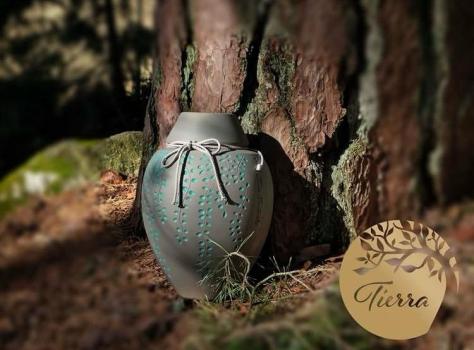
At the heart of Pia’s artistic practice is raw Finnish clay, completely biodegradable and returned to the natural cycle.
Whether creating large-scale public installations using ancient excavated soil or intimate hand-sculpted urns, Pia approaches materials with profound respect because for her, ecology is not a trend or a marketing value but an ethical foundation: what is taken from the earth must be returned with care.
Urns entered Pia’s life not by design, but through seemingly random intersections (a moment in Italy, a call from an old ceramics teacher) that led her on a path where everything she had experienced and learned found its place.
Becoming an urn maker wasn’t a career choice; it was the answer to a calling.
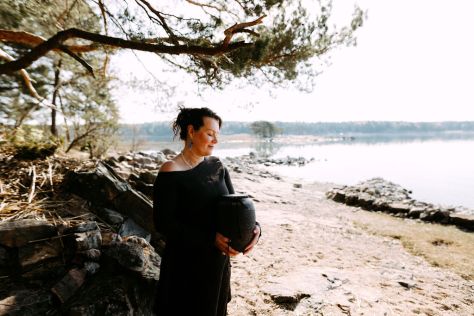
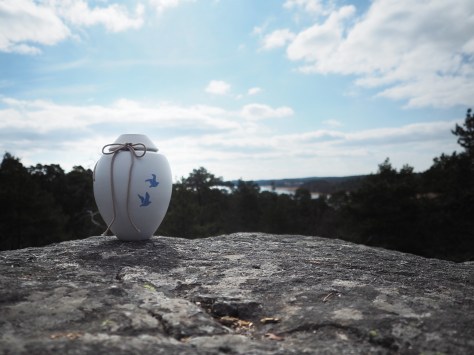
Pia doesn’t create urns as objects, but as gifts, each urn slowly crafted by hand and guided by intuition rather than biography, allowing form, symbol, and material to convey a meaning beyond words.
She uses raw Finnish clay, which is completely biodegradable and returns to the natural cycle, because clay and ash nourish the earth and sustain new life.
A personalized urn is born not from facts or biographies, but from what Pia has intuited after listening to an emotion or perceiving a recurring image that will guide the creation process, which can only be intimate and profoundly human.
The urn encapsulates a life lived, love, and memories in a way that words can’t always capture.
For those grieving, the urn holds profound meaning because it’s often the first object they touch after a loss, and many speak of receiving more than they expected: comfort, peace, and the feeling that the bond isn’t over, but has changed shape.
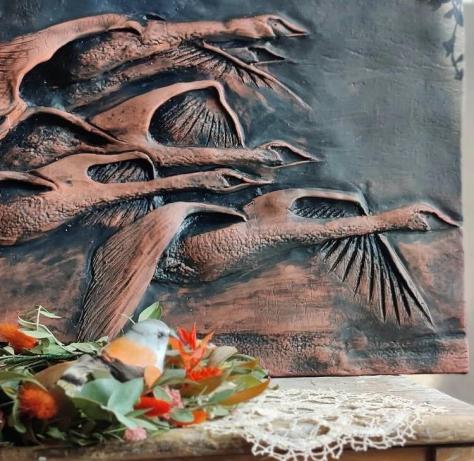
As an artist, Pia also works in public art, and her works literally emerge from the ground, like the reliefs created from millennia-old clay excavated beneath Turku’s Market Square. These works connect the city’s archaeological layers with the present moment and the movement of people. They are silent reminders of time, continuity, and the awareness that we are only one layer in a much longer journey.
Pia’s work isn’t limited to an urn, a work of art, or a single moment, but lives on in people, in memories, and in the earth itself. Through clay, she makes visible what we often forget:
that life is limited, incomplete, and imperfect, and therefore beautiful.
That death is not the opposite of life, but part of it.
And that love doesn’t disappear, but continues its journey.
Pia’s urns are internationally recognized for redefining how death can be approached: with dignity, beauty, and honesty.
Pia is also a death awareness advocate and a founding member and president of Pro Morte, an organization dedicated to reshaping the way societies talk about death, grief, and remembrance.
She firmly believes that the more courage we have in facing death, the more deeply we learn to live. As a mentor and guide, Pia opens clay to the living as well. In her workshops, clay becomes a tool for emotional expression, liberation, and the search for one’s inner voice.
You can find more information about Pia and her artistic work on her social media pages Instagram, Facebook, Linkedin, Youtube and on her website, tierrafinlandia.
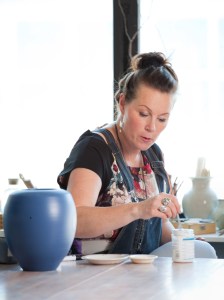 Pia Zettinig con Tierra Finlandia plasma la vita attraverso l’argilla
Oggi ho il piacere di presentarvi l’artista finlandese Pia Zettinig di Turku, dove è nata e vive lavorando nel suo studio artistico “ Tierra Finlandia ”.
Pia è un’artista visiva con una spiccata ma direi soprattutto naturale capacità di plasmare l’argilla in forme che contengono spazio per la vita, la morte e le transizioni intermedie.
La sua pratica spazia dall’arte pubblica ai rilievi scultorei e alle urne cinerarie ecologiche: opere che fondono artigianato, etica e intelligenza emotiva
L’argilla è entrata molto presto nella sua vita essendo cresciuta circondata dall’arte già da bambina quando ha iniziato a modellare l’argilla sul tornio della madre e ha trascorso del tempo nello studio del maestro ceramista finlandese Abbe Kantor.
L’argilla per Pia non è mai stata solo un materiale, ma anzi è diventato un linguaggio con cui lei si è connessa con il mondo passando attraverso il suo io interiore.
Questa connessione l’ha sempre accompagnata, anche quando la vita l’ha portata altrove.
Prima di dedicarsi completamente all’arte, Pia ha studiato in ambito sanitario e ha lavorato per oltre vent’anni come fisioterapista, terapista e guida in diverse parti del mondo, incontrando persone nei loro momenti più vulnerabili: ai margini del dolore, della malattia, della nascita, della perdita e della trasformazione e questo background ha influenzato profondamente il suo approccio artistico.
Le sue opere non sono solo oggetti, ma veri e propri incontri emotivi che trasudano il vissuto di una vita intera, dove un essere umano è più di un corpo e la vita molto più di singoli momenti misurabili.
La vita ha portato Pia in Canada, negli Stati Uniti e in Nuova Zelanda, ma le ha anche portato una profonda perdita e momenti brutti, tra cui un incendio che ha distrutto la sua casa e quasi tutti i beni materiali.
Attraverso queste prove che le ha riservato la vita, Pia ha compreso che nulla è permanente e proprio per questo tutto conta.
La vita e il lavoro di Pia sono cresciuti a strati, proprio come la terra che plasma con le sue mani e il suo percorso non è mai stato lineare o pianificato in precedenza, ma al contrario si è formato strato dopo strato attraverso esperienze, perdite, incontri e una chiamata interiore che a un certo punto della sua vita non ha più potuto ignorare.
Al centro dell’attività artistica di Pia c’è l’argilla finlandese cruda, completamente biodegradabile e restituita al ciclo naturale.
Che si tratti di realizzare installazioni pubbliche su larga scala con antichi terreni di scavo o di urne intime modellate a mano, Pia si avvicina ai materiali con profondo rispetto perché per lei l’ecologia non è una tendenza o un valore di marketing ma è un fondamento etico, ciò che viene preso dalla terra deve essere restituito con cura.
Le urne sono entrate nella vita di Pia non in modo pianificato, ma grazie a quegli incroci apparentemente casuali della vita ( un momento in Italia, la chiamata di un vecchio insegnante di ceramica ) che l’hanno condotta su un percorso in cui tutto ciò che aveva vissuto e imparato ha trovato il suo posto.
Diventare una creatrice di urne non è stata una scelta di carriera, è stata la risposta a una vocazione.
Pia non crea urne come oggetti, ma modella dei doni, dove ogni urna è realizzata lentamente a mano e guidata dall’intuizione piuttosto che dalla biografia, consentendo a forma, simbolo e materiale di trasmettere un significato che va oltre le parole.
Utilizza argilla finlandese cruda, completamente biodegradabile e che ritorna al ciclo naturale, perché argilla e ceneri nutrono la terra e sostengono nuova vita.
Un’urna personalizzata non nasce da fatti o biografie, ma da quello che Pia ha intuito dopo aver ascoltato un’emozione o percepito un’immagine ricorrente che guideranno il processo della lavorazione che non potrà che essere intimo e profondamente umano.
L’urna racchiude una vita vissuta, amore e ricordi in una forma che le parole non sempre riescono a raggiungere.
Per chi soffre, l’urna ha un significato profondo perché è spesso il primo oggetto che tocca dopo una perdita e molti parlano di aver ricevuto più di quanto si aspettassero: conforto, pace e la sensazione che il legame non sia finito, ma abbia cambiato forma.
Come artista, Pia lavora anche nell’arte pubblica e le sue opere nascono letteralmente dal terreno, come i rilievi creati con l’argilla millenaria scavata sotto la Piazza del Mercato di Turku. Queste opere collegano gli strati archeologici della città con il momento presente e il movimento delle persone. Sono silenziosi promemoria del tempo, della continuità e della consapevolezza che siamo solo uno strato in un viaggio molto più lungo.
Il lavoro di Pia non si esaurisce in un’urna, un’opera d’arte o un momento, ma vive nelle persone, nei ricordi e nella terra stessa, perché attraverso l’argilla, rende visibile ciò che spesso dimentichiamo:
che la vita è limitata, incompiuta e imperfetta, e quindi bella.
Che la morte non è l’opposto della vita, ma parte di essa.
E che l’amore non scompare, ma continua il suo viaggio.
Le urne funerarie di Pia sono riconosciute a livello internazionale per aver ridefinito il modo in cui la morte può essere affrontata: con dignità, bellezza e onestà.
Pia è anche una sostenitrice della consapevolezza della morte e membro fondatore e Presidente dell’associazione Pro Morte, un’organizzazione dedicata a rimodellare il modo in cui le società parlano di morte, dolore e ricordo.
Lei crede fermamente che più coraggio abbiamo nell’affrontare la morte, più profondamente impariamo a vivere e come mentore e guida Pia apre l’argilla anche ai vivi e nei suoi workshop, l’argilla diventa uno strumento per l’espressione emotiva, la liberazione e la ricerca della propria voce interiore.
Troverete maggiori informazioni su Pia e la sua attività artistica sulle sue pagine social Instagram, Facebook, Linkedin, Youtube e sul suo sito tierrafinlandia







 With great pleasure today I introduce you to the
  Pau
Pau
 Paula Mikkilä Suomesta, menneisyyden ja nykyisyyden rajalla, matka taiteeseen isolla alkukirjaimella


 giuseppe genta blog